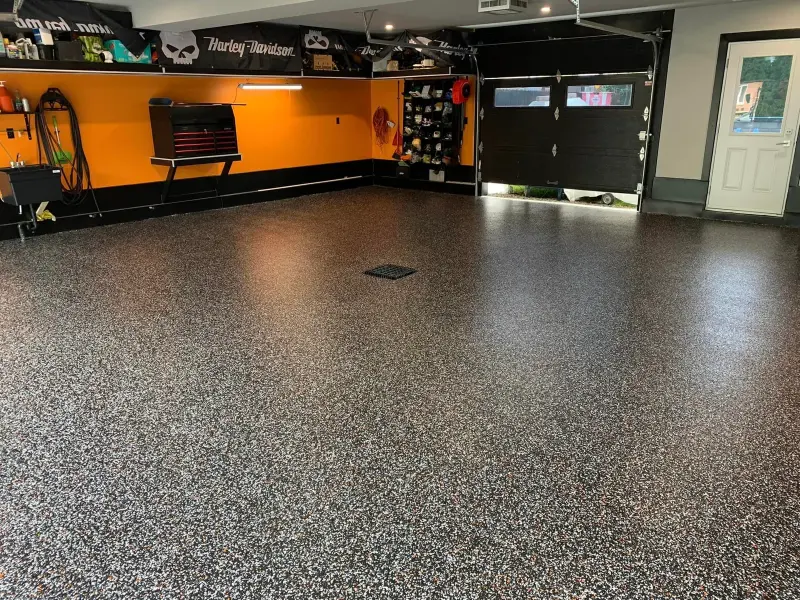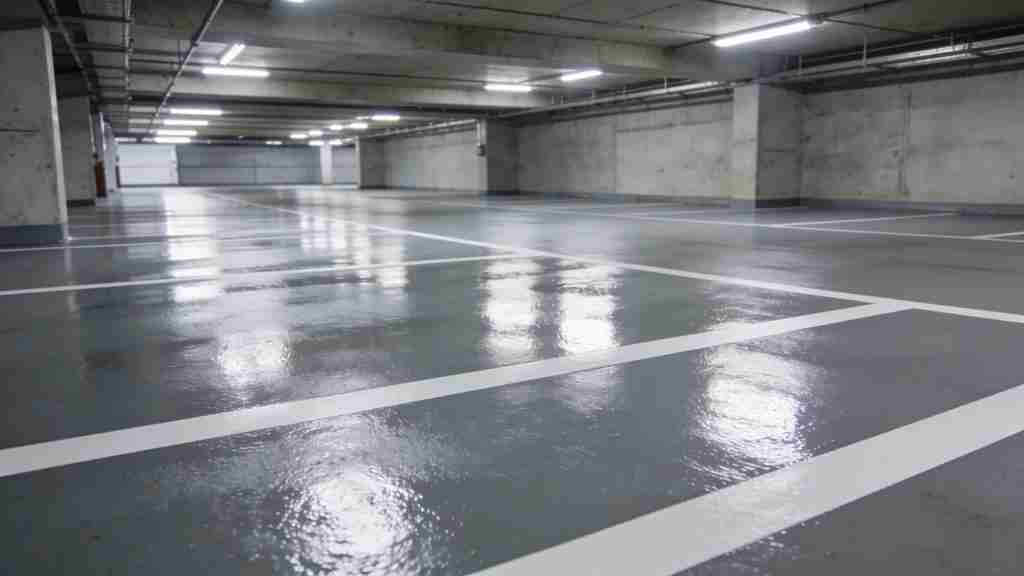
Why Indoor Parking Garages Choose Epoxy
An indoor parking garage takes a beating: cold tires spinning on the slab, road salt dragged in by cars all winter, oil, brake-fluid drips, constant traffic.
Bare concrete doesn’t hold up to that. It dusts, stains, soaks up salt, and eventually spalls at the surface.
That’s why more and more property managers and condo boards across Greater Montreal are coating their slab with a 100% solids epoxy system: it seals the concrete, resists chemicals, and cleans up with a pressure washer. Here are the real reasons behind that choice.
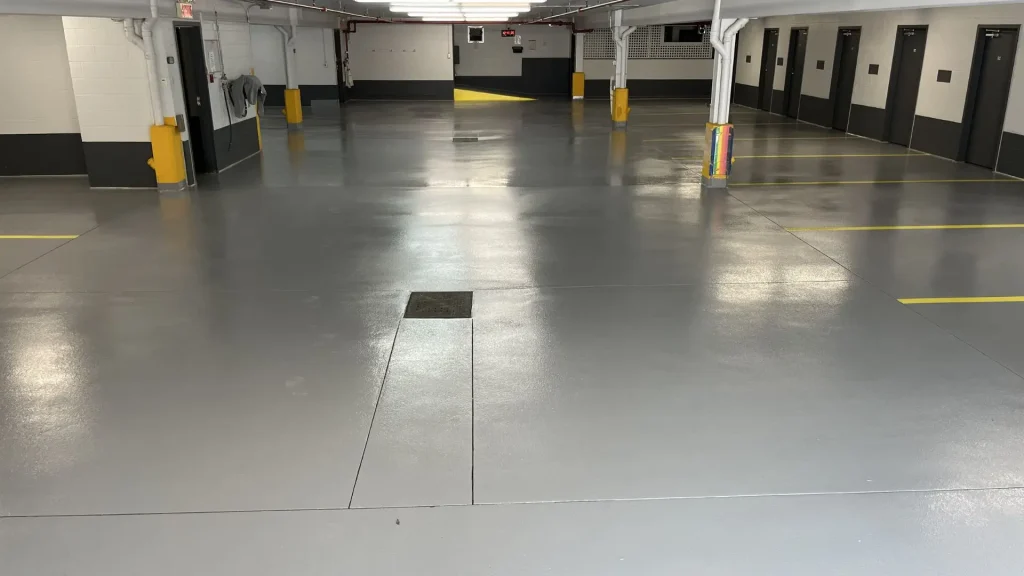
Key Takeaways
- Bare concrete doesn’t survive an indoor parking garage: road salt and oil migrate into the pores and, with freeze-thaw, make the slab scale.
- A 100% solids epoxy system seals the concrete and creates a chemically inert barrier against salt, oil, and antifreeze.
- Five reasons to switch to epoxy: durability under load, salt resistance, anti-slip safety, pressure-washer maintenance, and brightness with built-in line marking.
- Prep makes the difference: moisture test, diamond grinding, and pyrite/crack assessment. That’s what backs the 15-year warranty against delamination.
- Price: complete epoxy system from $7.00 to $8.50 per square foot, firm price after assessment, no hidden fees.
Bare Concrete Doesn't Survive an Indoor Parking Garage
A concrete slab is porous. It absorbs water, oil, and above all the chloride from the de-icing salt cars bring in off the street. Chloride migrates into the pores, attacks the cement paste, and with freeze-thaw cycling it causes surface scaling. The result: a slab that dusts, cracks that open up, permanent oil stains, and a surface that turns slick when wet.
A resin system fixes the problem at the source. The epoxy base coat penetrates and seals the concrete pores, then the polyurethane or polyaspartic topcoat forms a chemically inert barrier. Salt, oil, and water sit on the surface instead of eating into the slab. That’s the difference between maintaining a floor and replacing a slab.
Five Reasons Indoor Parking Garages Switch to Epoxy
1. Durability Under Heavy Loads
A 100% solids epoxy system laid over properly prepared concrete takes vehicle weight, impact, and tire abrasion without delaminating. No solvent-based products that shrink as they cure: the resin stays full-thickness and bonds to the substrate through mechanical anchoring. On a high-traffic garage, we broadcast quartz aggregate into the base coat to add mechanical strength and film thickness.
2. Salt and Chemical Resistance
This is the number-one argument in Quebec. Calcium-chloride de-icers and road salt eat away at standard concrete season after season. Resin layers are chemically inert: they don’t react to salt, oil, brake fluid, or antifreeze. The slab is protected exactly where it’s most vulnerable, at the surface and in the wheel paths.
Resin layers are chemically inert: they don’t react to salt, oil, brake fluid, or antifreeze. The slab is protected exactly where it’s most vulnerable, at the surface and in the wheel paths.
3. Anti-Slip Safety
An indoor garage stays wet through much of the winter: melting snow, slush, condensation. A slick surface means slip risk for pedestrians and skid risk for vehicles.
The topcoat is loaded with an anti-slip aggregate dosed to the site’s use, which gives reliable traction without making the floor hard to clean. We tune the slip resistance to the reality of the site.
4. Easy Maintenance
A sealed epoxy surface holds neither concrete dust nor oil stains. Cleaning is done with a pressure washer or auto-scrubber, no harsh degreaser needed. No more dusting concrete you sweep endlessly. For a property manager, that means fewer maintenance hours and a slab that keeps its look for years.
5. Brightness and Built-In Line Marking
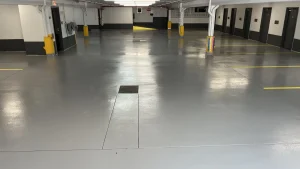
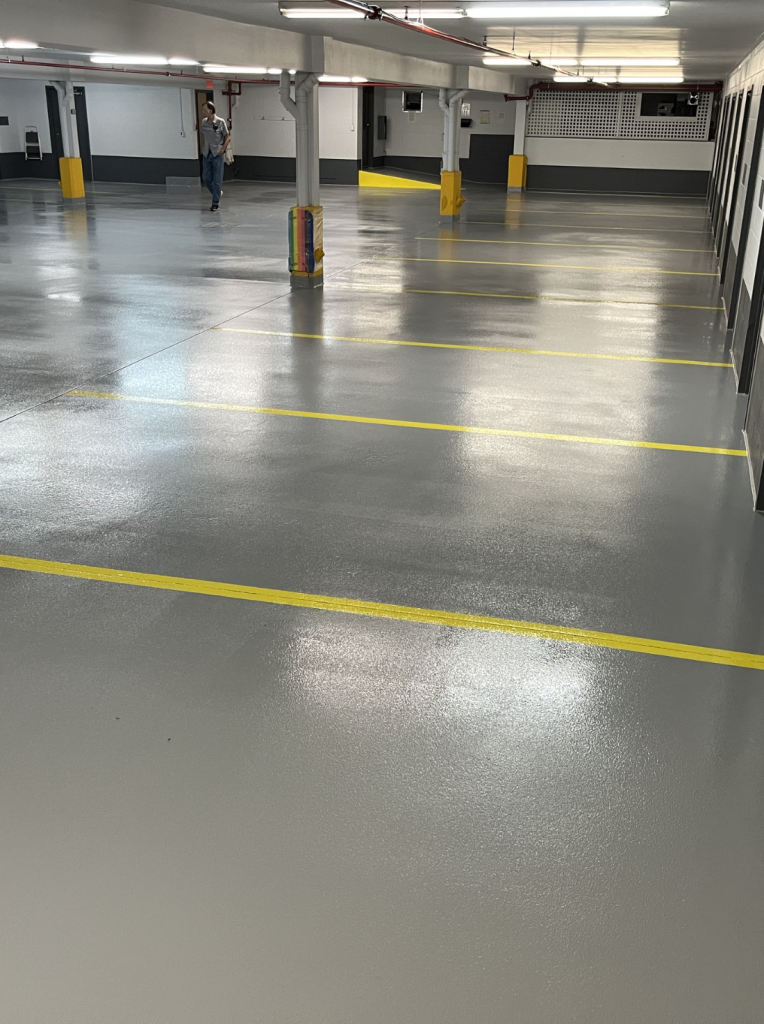
A light, reflective floor bounces the light from the fixtures and makes the garage brighter, and therefore safer.
We build the parking lines, pedestrian zones, and stall numbers directly into the system, with resin marking that doesn’t peel like traffic paint. The contrast stays sharp for the full life of the floor.
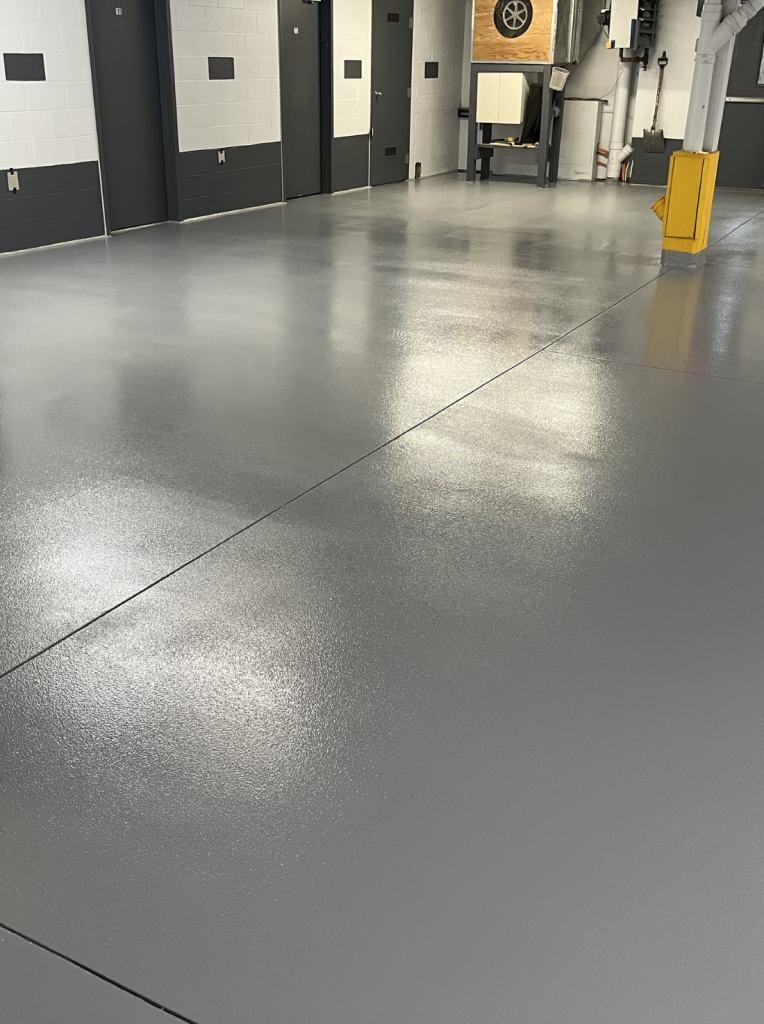
The System We Install
A Bétonik indoor parking floor is a multi-layer system, not a coat of paint:
- Mechanical concrete prep by diamond grinding or shot blasting to open the surface profile (CSP) and guarantee adhesion.
- Primer coat, with a moisture-vapor barrier if the test calls for it.
- 100% solids epoxy base coat, broadcast with quartz aggregate in heavy-traffic zones.
- Anti-slip polyurethane or polyaspartic topcoat, UV-stable for exposed areas.
- Resin line and zone marking.
Polyaspartic can go over epoxy, but never the other way around. The topcoat choice depends on UV exposure, traffic, and return-to-service timing.
What Separates a Floor That Holds from a Floor That Peels
The resin isn’t the problem when a parking floor delaminates after a year or two. It’s almost always the prep. An installer who paints epoxy straight onto smooth, damp, or contaminated concrete is setting up a peel. At Bétonik, we’re trained concrete finishers before we’re epoxy applicators, so we treat the concrete first:
Mandatory moisture test. A slab-on-grade, especially in a basement, wicks moisture up by capillary action. We measure the rate before applying anything. If moisture is high, we install a moisture-vapor barrier. Laying epoxy over a slab that breathes guarantees blisters.
Grinding, no shortcuts. We open the concrete pores by diamond grinding or shot blasting. A smooth or sealed surface gives the resin nothing to grip. The surface profile is what creates the mechanical anchor.
Pyrite and crack assessment. In some areas, pyrite swells the slab. Active cracks reopen under the resin if they’re not treated. We assess all of that on site before quoting a price.
That rigor is what lets us back the work with a 15-year warranty against delamination, one of the strongest in Quebec.
What an Indoor Parking Epoxy Floor Costs
A complete epoxy system (base coat, aggregate, anti-slip topcoat) runs between $7.00 and $8.50 per square foot, depending on the state of the concrete, the prep required, the finish type, and the marking. A slab that needs a lot of crack repair or a moisture barrier costs more up front, but that’s exactly what keeps you from redoing everything in two years. We give a firm per-square-foot price after assessment, with no hidden fees.
Get a free assessment: have your indoor parking garage protected by trained concrete finishers.
See also our indoor parking protection page and our commercial epoxy page.
Frequently Asked Questions
Everything You Need to Know About Our Services.
Will epoxy crack under the weight of cars?
No, not if the concrete is properly prepared. The resin follows the slab: if the slab is sound and the prep is done right, the system takes vehicle weight and tire abrasion. Cracks that show up come from an untreated slab underneath, not from the resin.
Can epoxy be applied to a parking garage that's already in service?
Yes. We work in zones to keep part of the garage accessible during the job. Return to service depends on the system and temperature, usually 24 to 72 hours of cure per section.
Will the floor be slippery in winter with melting snow?
No. We load the topcoat with an anti-slip aggregate dosed for the site’s use. Traction stays reliable even when wet, while keeping the surface easy to clean.
How long does it last?
A properly prepped and maintained system lasts many years under commercial traffic. Our warranty against delamination is 15 years.