
Residential Epoxy in Greater Montreal
Residential epoxy flooring
An aesthetic and easy-to-clean floor that protects your slab against calcium and crumbling for the next 15 years.
Residential Epoxy in Greater Montreal
Durable, oil-resistant garage epoxy flooring in Montreal
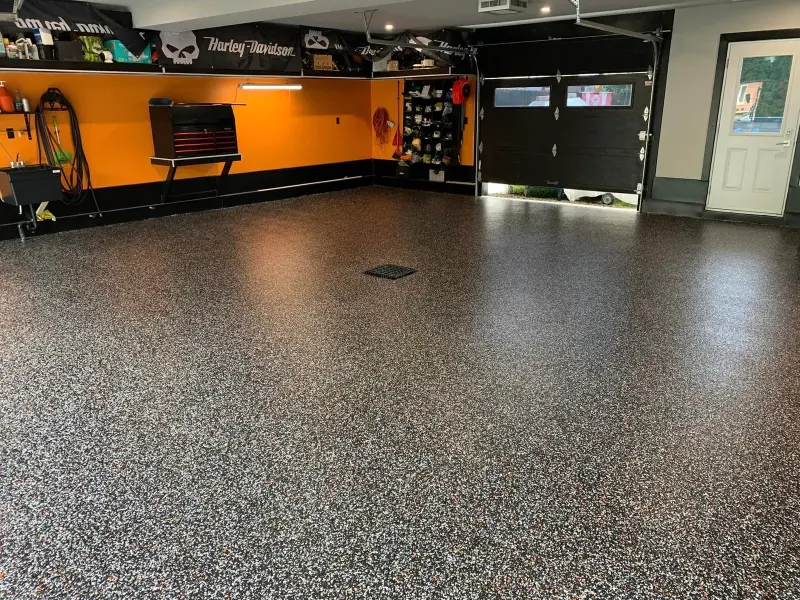
Looking to upgrade your garage or living room floors? Look no further! Our epoxy floor coatings are the perfect solution for a stylish and durable floor that will make your garage the envy of the neighborhood. We offer a wide variety of products and finishes for your epoxy coating projects.
Basement Floor
Kitchen Floor
Residential Epoxy in Greater Montreal
Why Choose Residential Epoxy for Your Home
We don’t just “patch.” Our team refurbishes your slab to ensure perfect adhesion and an industrial-grade finish.
- 15-Year Warranty: Real protection against peeling.
- Deep Preparation: Diamond grinding to open the cement pores and ensure proper adhesion.
- 100% Solid Products: Use of flexible polyaspartic that does not yellow in the sun.
- Certified Expertise: Work performed by cement finishers holding their competency cards and RBQ license.

Residential Epoxy in Greater Montreal
Our Installation Process
Bétonik Inc. provides the best warranty on the market.
By choosing us, you are choosing a trustworthy company with over 15 years of experience.
Before any application, we perform a complete visual analysis to detect signs of pyrite, moisture, or cracks. We then proceed to grind the slab to open the concrete pores, ensuring the resin anchors solidly rather than simply “patching” the surface.
We use 100% solid industrial-grade products. The resin is precisely mixed with its hardener to create a durable solution that will protect your floor.
The resin base is applied evenly across the entire surface. At this stage, we incorporate the chosen style and color, whether it is a standard supplier color sample or a custom special order to meet your tastes.
To finish, a protective layer (often polyurethane or polyaspartic) is applied. This leveling finish eliminates air bubbles and, most importantly, prevents yellowing of the surface while offering durability certified by our 15-year warranty.
Book Today
Local expertise extending throughout Montreal and the surrounding areas!
We serve a wide territory to meet your needs for epoxy and concrete floor refurbishment.
Lanaudière
- Joliette
- L'Assomption
- Lavaltrie
- Mascouche
- Rawdon
- Repentigny
- St-Charles-Borromée
- Ste-Julienne
- St-Lin-Laurentides
- Terrebonne
Laurentians
- Blainville
- Boisbriand
- Bois-des-Filion
- Deux-Montagnes
- Mirabel
- Rosemère
- Ste-Anne-des-Plaines
- Ste-Marthe-sur-le-Lac
- Ste-Thérèse
- St-Eustache
- Verdun
- Plateau Mont-Royal
- Saint-Laurent
- Westmount
- Dorval
- Dollard-des-Ormeaux
- Ahuntsic
- Anjou
- Montreal West
Frequently Asked Questions
Everything You Need to Know About Our Services.
Can epoxy be applied to polished concrete?
It is generally not recommended to apply epoxy directly onto concrete that is already polished to a high gloss. Polishing closes the pores of the concrete, which prevents the epoxy from bonding properly. For epoxy to adhere, the surface must first be “opened” by diamond grinding to create a rough surface profile.
What are the disadvantages of an epoxy floor coating on concrete?
Moisture Sensitivity: If the concrete slab releases too much water vapor, the epoxy can bubble or peel.
Rigidity: Pure epoxy has little flexibility and can crack if the building structure moves slightly.
Yellowing: Standard epoxy is not UV stable and eventually yellows if exposed to direct sunlight.
Heavy Preparation: Quality depends 100% on the initial preparation (grinding and cleaning).
How to apply epoxy paint to a concrete floor?
The professional application by Bétonik inc. follows a rigorous process:
Preparation: Slab analysis (pyrite, moisture) and grinding to open the pores.
Mixing: Precise fusion of resin and hardener.
Application: Even spreading of the resin on the prepared floor.
Finishing: Application of a leveling protective layer to eliminate air bubbles and prevent yellowing.
What is the difference between polyurethane and polyaspartic?
Polyurethane: Highly resistant to scratches and chemicals, often used as a protective topcoat.
Polyaspartic: This is an advanced version of polyurethane. It dries much faster (allowing for one-day installation), can be applied at various temperatures, and offers superior resistance to UV rays and impacts.
Can polyaspartic be applied over polyurea?
Yes, it is actually a common practice. Polyurea is often used as a base coat (primer) due to its excellent adhesion to concrete and flexibility, while polyaspartic is applied over it as a topcoat for its UV resistance and long-lasting gloss. These two products belong to the same chemical family and are perfectly compatible.
Book today for 2026
Transform your home with our expert services
A leader in Quebec for epoxy flooring and polished concrete work, Bétonik provides the best warranty on the market. By choosing Bétonik, you are selecting a trustworthy company with over 15 years of experience.