Polyurea vs Polyaspartic: Which Coating Should You Choose for Your Garage?
When you shop for a garage floor, two words keep coming up: polyurea and polyaspartic. Salespeople pit them against each other like two enemy camps. The reality is simpler, and a manufacturer confirms it: polyaspartic is an aliphatic polyurea. So the real question isn’t “which of the two,” but which topcoat goes on your system, and why. We install garage epoxy floors year-round across Greater Montreal. Here’s how we decide, as trained concrete finishers.
Key Takeaways
- Polyaspartic is a subtype of polyurea (aliphatic polyurea), not its opposite.
- UV stability: polyaspartic doesn’t yellow in the sun; an aromatic polyurea does.
- Working time: polyaspartic gives roughly 20 to 30 minutes of application time, enough for a clean job, while still curing fast.
- The topcoat always goes over an epoxy base with flakes, never on its own. Polyaspartic is applied over epoxy.
- What makes the floor last is the concrete prep, not the brand of topcoat. 15-year warranty against delamination.
The Short Answer: Which One for a Garage?
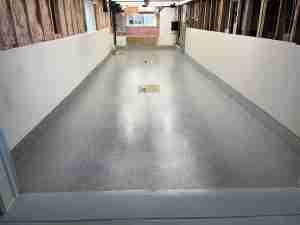
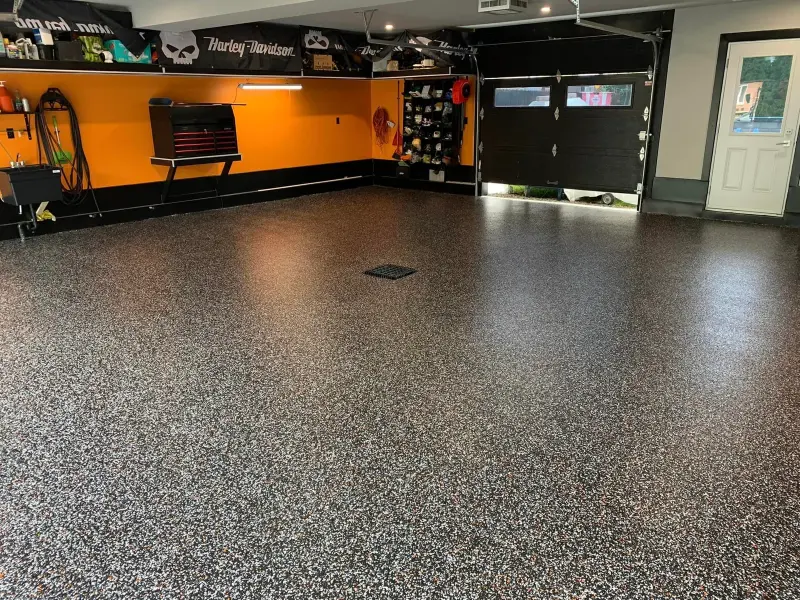
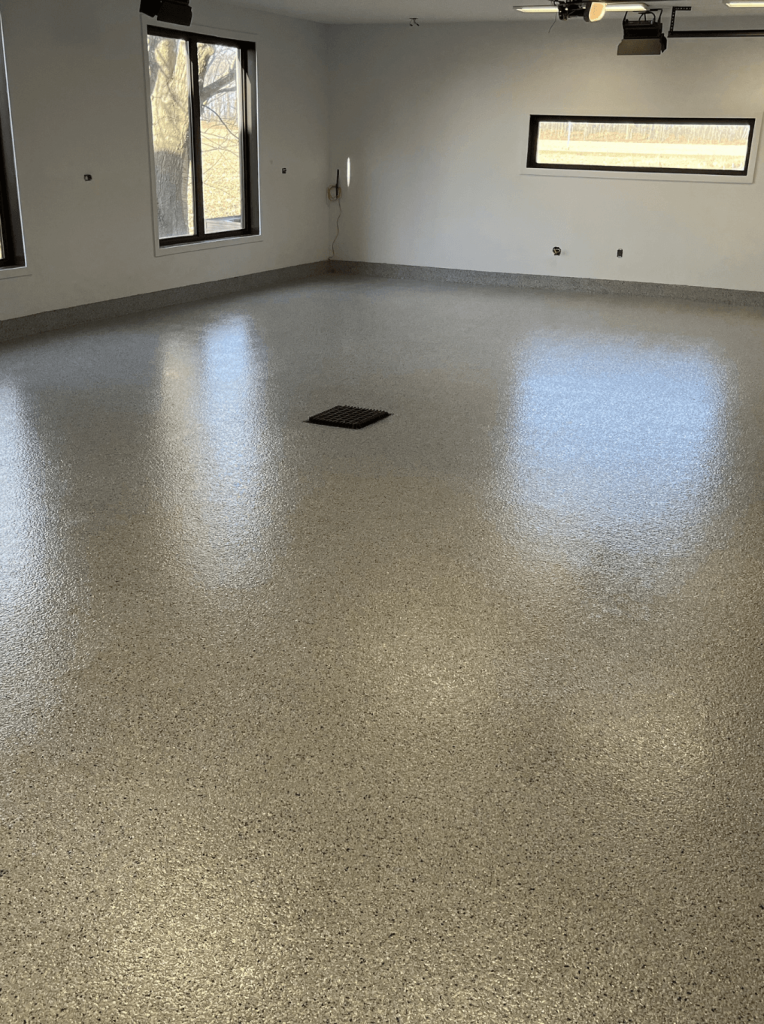
For a residential garage, we almost always install a 100% solids epoxy base, a layer of flakes, then an anti-slip polyaspartic topcoat.
Polyaspartic delivers UV stability, clarity, and abrasion resistance, without the yellowing risk of an aromatic polyurea. Fast-set polyurea still has its place on some industrial floors, but in a garage its very short working time complicates the job with no real benefit to you.
It’s the same reasoning we apply across our whole range of residential epoxy.
Polyurea and Polyaspartic: The Real Difference
Polyaspartic isn’t a competitor to polyurea. It’s a modified version of the same chemistry.
According to technical distributor Pflaumer, polyaspartic is “an aliphatic polyurea” whose steric hindrance slows the extreme reactivity of classic polyureas. In other words, the real debate isn’t polyurea versus polyaspartic, but aromatic polyurea versus aliphatic polyurea.
Aromatic Polyurea
Aromatic polyurea cures very fast and forms a thick, impact-resistant film. It’s excellent in industrial settings, where speed of return to service comes first.
But this chemistry isn’t UV-stable: exposed to sunlight, it tends to yellow over time. Its ultra-fast set also leaves very little time to spread and correct, which demands a fast, experienced crew.
Aliphatic Polyaspartic
Aliphatic polyaspartic was designed for two specific reasons: to stay UV-stable and to offer a longer working time. It doesn’t yellow, keeps its clarity, and resists abrasion and chemicals well. Sherwin-Williams describes it as offering “superior wear and chemical resistance” and “UV-stable protection.” It’s the topcoat we favor on garage floors.
Sherwin-Williams describes it as offering “superior wear and chemical resistance” and “UV-stable protection.” It’s the topcoat we favor on garage floors.
| Criterion | | Aromatic polyurea | |Polyaspartic (aliphatic) |
|---|---|---|
| UV stability | |Yellows in the sun | |Stable, doesn’t yellow |
| Working time | |Very short (fast set) | |About 20 to 30 minutes |
| Return to service | |Fast | |Tack-free in ~1 h, next day |
| Application | Topcoat | Topcoat sur base époxy |
| Ideal use | |Industrial floors | |Residential garage |
UV and Yellowing: Why It Matters Even in a Garage
People often say UV only matters outdoors. Not true for a garage. The area near the door gets direct sun every time you open it in summer, and many garages have windows. That’s where an aromatic polyurea yellows first, while the rest of the floor stays light. The result: an uneven color patch you can’t fix without redoing the finish.
Polyaspartic solves the problem through its chemistry. Aliphatic compounds provide UV stability and color retention. A polyaspartic topcoat therefore keeps an even tone across the whole surface, entrance zone included. For a floor you want to look good as much as last, that’s a concrete argument, not marketing.
Set Time and Working Window
Here’s the trade-off few salespeople explain. Polyaspartic gives roughly 20 to 30 minutes to apply by roller or brush, then becomes tack-free in about an hour, with return to service as soon as the next day. Sherwin-Williams notes a cure as fast as 2 hours per coat. So you get the speed without the rush.
Why does your installer often prefer polyaspartic? Because that 20-to-30-minute window allows a clean job: spreading the flakes evenly, releasing air bubbles, reworking an edge.
A fast-set polyurea forgives nothing. On a residential garage floor where looks matter, a controllable working time shows in the final finish.
What Matters More Than the Topcoat's Name: Prep
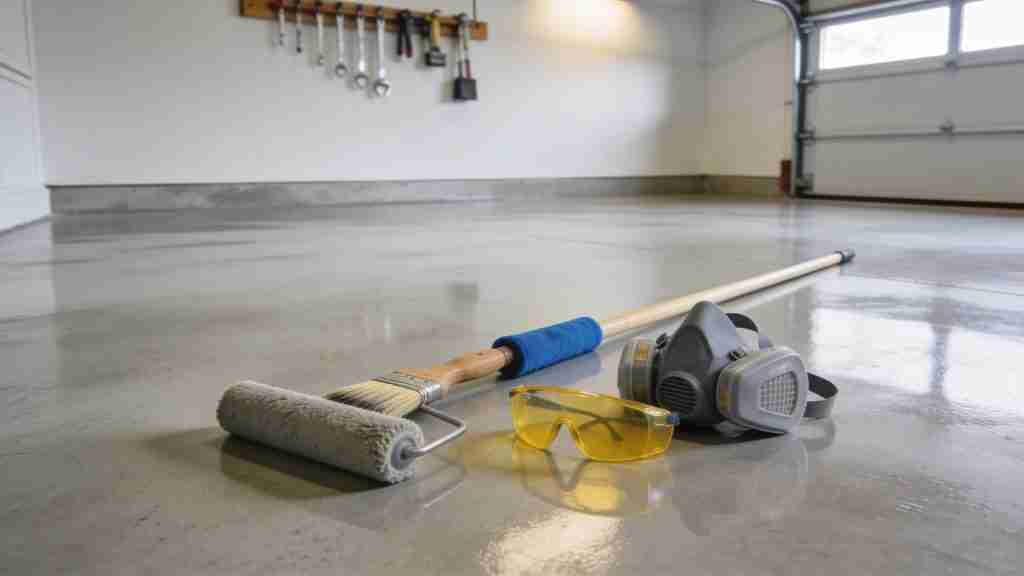
The polyurea-or-polyaspartic choice makes a difference, but a smaller one than this: the concrete prep.
A premium topcoat laid over a poorly prepped slab delaminates anyway. Both resins are applied as a topcoat over an epoxy base; polyaspartic goes over epoxy without issue. Performance therefore depends as much on the slab as on the product.
At Bétonik, we’re trained concrete finishers before we’re resin applicators, so we treat the concrete first:
- Mandatory moisture test, with a moisture-vapor barrier if the reading calls for it.
- Diamond grinding or shot blasting to open the surface profile (CSP) and create the mechanical anchor.
- On-site assessment of pyrite and cracks before quoting a price.
That rigor, not just the brand of topcoat, is what lets us back the work with a 15-year warranty against delamination. The same principle applies to a basement epoxy floor, where rising damp is even more critical.That rigor, not just the brand of topcoat, is what lets us back the work with a 15-year warranty against delamination. The same principle applies to a basement epoxy floor, where rising damp is even more critical.
How Much Does a Garage Floor Cost?
A complete garage floor (100% solids epoxy base, flakes, anti-slip polyaspartic topcoat) runs between $7.00 and $8.50 per square foot, depending on the state of the concrete and the prep required. A standard two-car garage is usually 400 to 600 sq ft. We give a firm per-square-foot price after assessment, with no hidden fees. No surprises along the way.
Frequently Asked Questions
Everything You Need to Know About Our Services.
What's the best garage floor coating?
For most garages across Greater Montreal, a 100% solids epoxy system with flakes and an anti-slip polyaspartic topcoat. You get adhesion, UV stability, salt resistance, and an anti-slip finish. Final quality depends mostly on the concrete prep, not just the product.
What are the downsides of a polyaspartic coating?
Its working time is short, about 20 to 30 minutes, so installation demands an experienced crew: it’s not a DIY project to take lightly. As a topcoat, it goes over a well-prepped epoxy base, never straight onto neglected concrete.
What are the downsides of polyurea?
Its working time is short, about 20 to 30 minutes, so installation demands an experienced crew: it’s not a DIY project to take lightly. As a topcoat, it goes over a well-prepped epoxy base, never straight onto neglected concrete.
Polyaspartic or polyurea: which is better?
Neither is “better” in absolute terms, since polyaspartic is already an aliphatic polyurea. For a residential garage, polyaspartic wins: UV-stable, longer working time, cleaner finish. Aromatic polyurea suits industrial floors most.
Sources
- Pflaumer, An Introduction to Polyaspartic Coatings, retrieved 2026-07-27, https://pflaumer.com/an-introduction-to-polyaspartic-coatings/.
- Sherwin-Williams, Polyaspartic Floor Coatings (Systems & Chemistry), consulté le 2026-07-27, https://industrial.sherwin-williams.com/na/us/en/resin-flooring/resources/systems-chemistry/polyaspartic-floor-coatings.html.